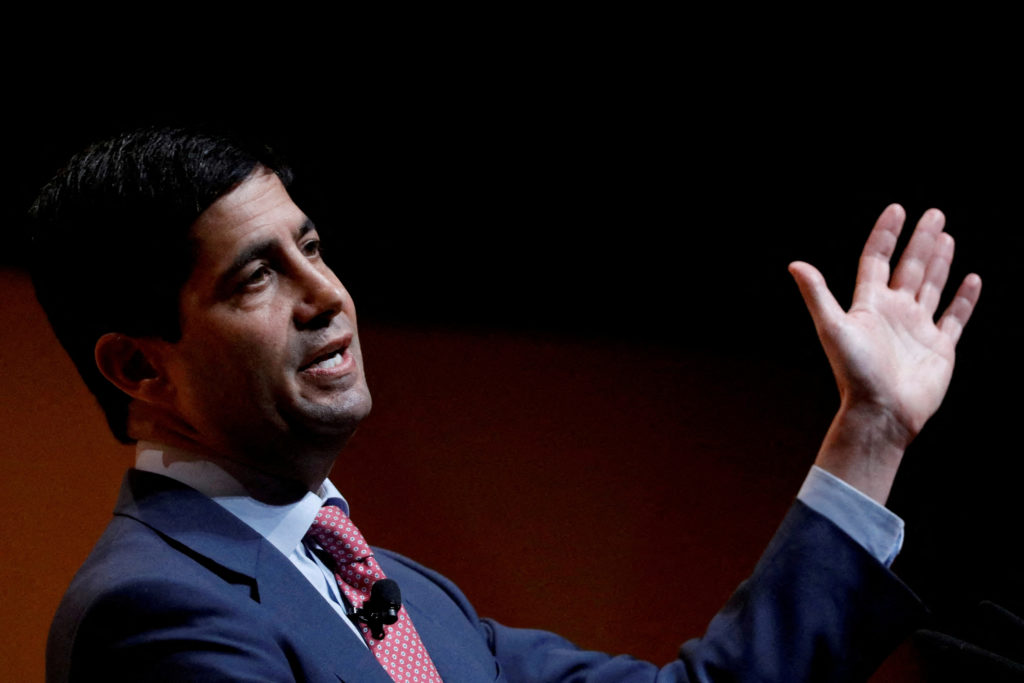
Warsh's Fed Chair Nomination Halted by Tillis Over Powell Probe
The political landscape surrounding the Federal Reserve's leadership has been thrown into disarray following President Donald Trump's nomination of Kevin Warsh as the next Fed Chair. While Warsh boasts a distinguished background and considerable experience, his path to confirmation has hit an unexpected and formidable roadblock. Senator Thom Tillis (R-N.C.) has announced his intention to block the nomination, not due to concerns about Warsh's qualifications, but rather as a principled stand against an ongoing Department of Justice (DOJ) investigation into current Fed Chairman Jerome Powell. This unprecedented move underscores the delicate balance between political appointments and the fiercely guarded independence of the nation's central bank.
The unfolding drama highlights a critical juncture for the Federal Reserve, an institution traditionally shielded from overt political pressure to ensure its ability to make impartial monetary policy decisions. As the debate intensifies, stakeholders from financial markets to main street businesses are watching closely, aware that the leadership of the Fed holds profound implications for economic stability, inflation, and employment.
The Nomination of Kevin Warsh: A Strategic Move by Trump
President Donald Trump's decision to nominate Kevin Warsh to lead the Federal Reserve, replacing Jerome Powell at the end of his term, signals a clear intent to reshape the nation's monetary policy direction. Trump has consistently voiced his desire for lower interest rates since taking office, and a new Fed Chair could potentially align more closely with this view. The official announcement from the White House on March 4 confirmed Warsh's nomination to serve a four-year term as Chair, along with a concurrent 14-year term on the Fed's Board of Governors.
Kevin Warsh brings a wealth of experience to the table, making him a compelling, albeit controversial, choice for many. He served as a Fed governor from 2006 to 2011, having been appointed by President George W. Bush during a period of significant economic turmoil, including the 2008 financial crisis. This tenure provided him with direct, hands-on experience in monetary policy formulation and crisis management. Prior to his time at the Fed, Warsh served as an economic aide in the George W. Bush administration, further cementing his credentials in high-level economic policy.
Beyond his government service, Warsh has remained a prominent figure in economic discourse. He currently serves as the Shepard Family Distinguished Visiting Fellow in Economics at the Hoover Institution and is a lecturer at the Stanford Graduate School of Business. Additionally, he is a Partner at Duquesne Family Office, a New York investment firm founded by the legendary Stanley Druckenmiller. These roles suggest a deep understanding of financial markets, academic rigor, and practical investment acumen – qualities that typically make a strong candidate for the Fed Chair. Indeed, the Independent Community Bankers of America (ICBA), through its President and CEO Rebeca Romero Rainey, publicly congratulated Warsh on his nomination, recognizing his expertise and potential contributions. For a deeper dive into his background and the discussions surrounding his candidacy, you might find this article insightful:
Who Is Kevin Warsh? Trump's Controversial Pick for Federal Reserve.
Senator Tillis's Stance: Protecting Fed Independence
Despite Warsh's impressive resume, his nomination has encountered an unexpected and significant hurdle in the Senate. Senator Thom Tillis (R-N.C.) has declared that he will block Warsh's nomination until the Department of Justice drops its criminal investigation into current Fed Chairman Jerome Powell. Tillis's uncompromising position stems from a profound concern for the independence of the Federal Reserve, an institution whose autonomy is considered vital for effective monetary policy.
The core of Tillis's objection lies in the DOJ's pursuit of a criminal investigation into Chairman Powell, reportedly based on committee testimony that the Senator argues "no reasonable person could construe as possessing criminal intent." Tillis explicitly articulated his reasoning: "Protecting the independence of the Federal Reserve from political interference or legal intimidation is non-negotiable." He further emphasized, "My position has not changed: I will oppose the confirmation of any Federal Reserve nominee, including for the position of Chairman, until the DOJ's inquiry into Chairman Powell is fully and transparently resolved."
This stance by Senator Tillis is not merely a political maneuver; it's a principled defense of a fundamental tenet of economic governance. The Federal Reserve's independence is crucial because it insulates monetary policy decisions from short-term political pressures. When politicians can exert undue influence over interest rates or the money supply, there is a risk that policy could be manipulated for electoral gain rather than for the long-term health of the economy. This could lead to cycles of boom and bust, inflation, or instability.
Historically, the Fed has been granted significant autonomy to make decisions based on economic data and expert analysis, rather than the whims of the current administration. Tillis's concern is that using a criminal probe, particularly one he views as baseless, against a sitting Fed Chair sets a dangerous precedent, potentially chilling future Chairs from making unpopular but necessary decisions. Such a situation could undermine global confidence in the U.S. financial system and its institutions.
The Broader Implications for the Federal Reserve and US Economy
The current standoff surrounding Kevin Warsh's nomination carries significant implications not just for the individuals involved but for the very functioning and credibility of the Federal Reserve and, by extension, the stability of the U.S. economy.
*
Uncertainty and Market Volatility: Prolonged uncertainty over Fed leadership can spook financial markets. Investors thrive on predictability, especially concerning monetary policy. A prolonged confirmation battle or a potentially vacant chair could lead to increased market volatility, hesitation in investment, and a general dampening of economic sentiment. Businesses, in particular, may delay expansion plans or hiring decisions in the face of an unpredictable monetary environment.
*
Weakening Fed's Authority: A Fed Chair under a perceived cloud of investigation, or a central bank constantly battling political interference, may find its authority diminished. This could complicate the Fed's ability to effectively manage inflation, ensure full employment, and maintain financial system stability. If the public and markets lose faith in the Fed's impartiality, its policy tools may become less effective.
*
Jerome Powell's Status: While Powell's term as Chair officially ends in May, he still has two more years as a Fed governor. Usually, chairs resign their governor terms after their chair term concludes to make a clean break. However, in this unique situation, it's unknown if he will. This "lame duck" period, combined with the ongoing DOJ probe, creates an awkward dynamic for the current leadership and future planning.
*
Precedent for Politicization: The central concern is the precedent this situation sets. If a sitting Fed Chair can be subjected to a criminal investigation based on committee testimony that is widely seen as legitimate, it opens the door for future administrations to use legal means as a political weapon against independent institutions. This could fundamentally alter the perceived independence of the Fed, pushing it closer to a government agency rather than an independent body.
*
Practical Tip for Businesses and Investors: During periods of such uncertainty, it's crucial to diversify portfolios and maintain liquid assets. Businesses should factor potential changes in interest rate policy and economic sentiment into their strategic planning. Keeping a close watch on congressional developments and public statements from key economic figures will be essential for informed decision-making. Understanding the nuances of this political gridlock is key, as explored further in this related piece:
Trump Taps Kevin Warsh for Fed Chair Amid Senate Gridlock.
Navigating Political Headwinds: The Future of Fed Leadership
The standoff initiated by Senator Tillis creates a complex and unpredictable path forward for the Federal Reserve's leadership. Several scenarios could unfold, each with its own set of implications for the institution and the broader economy.
One potential resolution involves the Department of Justice dropping its inquiry into Chairman Powell. If the DOJ concludes that there is no basis for criminal intent in Powell's testimony and closes the investigation, Tillis's stated condition would be met, theoretically clearing the way for Warsh's nomination to proceed to a Senate vote. However, the DOJ operates independently, and the timing or outcome of such a decision is entirely outside the control of either President Trump or Senator Tillis.
Alternatively, the pressure on Senator Tillis could mount, leading him to eventually relent and allow the nomination to move forward. This is less likely given his strong language about "non-negotiable" independence, but political landscapes can shift. Conversely, President Trump might decide to withdraw Warsh's nomination if it appears hopelessly stalled, opting instead to nominate a different candidate who might garner broader support or face fewer political obstacles. This would restart the entire nomination process, potentially leading to further delays.
The entire episode underscores the increasing politicization of institutions traditionally viewed as apolitical. While presidents always nominate Fed leaders, the direct intervention of a Senator blocking a nomination based on a DOJ probe into the *current* chair is unprecedented. This situation highlights the importance of transparent governance and the rule of law. It also challenges future administrations to consider the potential for such political headwinds when making critical appointments to independent bodies. The long-term challenge will be to find a way to appoint qualified individuals to the Federal Reserve while simultaneously safeguarding its essential independence from partisan interference. The integrity of the institution, and its capacity to steer the economy through future challenges, depends on it.
Conclusion
President Trump's nomination of Kevin Warsh to lead the Federal Reserve has been thrust into an extraordinary political deadlock, largely due to Senator Thom Tillis's principled stand. Tillis's refusal to consider Warsh's confirmation until the DOJ's investigation into current Fed Chair Jerome Powell is resolved underscores the profound importance of the Federal Reserve's independence. This ongoing saga introduces significant uncertainty into the nation's economic outlook, impacting financial markets and potentially challenging the very authority of the central bank. As the various political and legal forces play out, the ultimate resolution will not only determine the next leader of the Fed but could also set a critical precedent for the future relationship between political power and independent economic institutions. Navigating these turbulent waters will require deft political maneuvering, a firm commitment to institutional integrity, and a clear vision for the economic future of the United States.